Venetian Plaster — What It Is, How Much It Costs and Who It's For
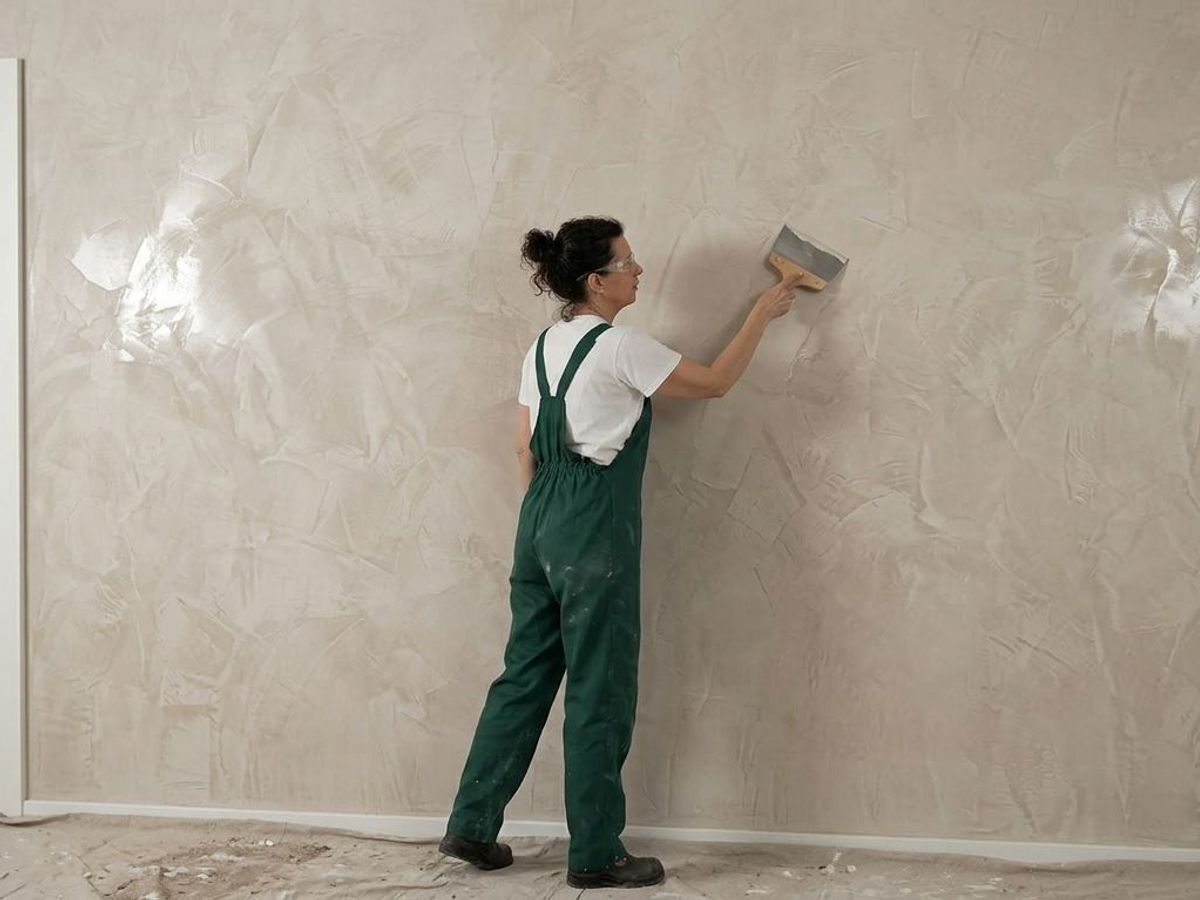
Venetian Plaster — What It Is, How Much It Costs and Who It's For
A client shows me a photo from Pinterest: a smooth, deep surface that looks like polished marble but ripples softly like clouds. "Is that wallpaper?" she asks. No. It's Venetian plaster — one of the oldest and most refined decorative techniques, which imitates marble without being marble.
In this article I explain exactly what Venetian plaster is, what it realistically costs in 2026 and who it makes sense for — and who it doesn't.
What Venetian plaster is
Venetian plaster (stucco veneziano) is a decorative compound based on lime putty and marble dust, applied in thin layers with a stainless steel trowel and then polished to a high gloss. The result is a surface with depth and a play of light that no paint can reproduce.
The technique originates in Renaissance Venice, where it was a cheaper and lighter alternative to solid marble — stone was heavy and expensive, and Venetian damp destroyed it. The lime compound solved both problems: it weighed a fraction of marble and "breathed" in the humid climate of the lagoon.
Today I work with top-grade materials such as San Marco Grassello di Calce — high-quality matured lime that gives the characteristic mirror-like finish of true Venetian plaster.
[IMAGE PLACEHOLDER 1: close-up of the Venetian plaster surface, visible play of light and depth. Caption: "Polished Venetian plaster — depth and gloss that paint cannot achieve."]
Venetian plaster vs other decorative plasters
Clients often confuse Venetian plaster with other techniques. A quick distinction:
Venetian plaster (Grassello) — smooth, mirror-like, with the effect of polished marble. The most elegant and classic.
Marmorino — also lime-based, but with a more cloud-like, matt or semi-matt structure resembling raw stone. Less gloss, more texture.
Decorative concrete / microcement — raw, industrial, matt. A completely different mood — modern minimalism rather than classic elegance.
Painted marbling — this is painting that imitates marble, not plaster. A cheaper alternative when you want the marble pattern (veins, blotches) without the physical depth of plaster.
Who Venetian plaster is for
Venetian plaster works if:
- You want timeless, classic elegance — this is not a trend that will date
- You want the effect of luxurious marble without the weight and cost of solid stone
- You have a feature wall — living room, hall, dining room, staircase — where the surface will be on show
- You value durability — well-executed Venetian plaster lasts for decades
It may not be for you if:
- You're after a cheap, quick refresh — this is an investment, not cosmetics
- You like frequent changes of décor — plaster is a choice for years, not for a season
- You have very uneven walls in poor condition — substrate preparation cost may exceed the plaster itself
[IMAGE PLACEHOLDER 2: Venetian plaster in an interior context — a wall in a living room or hall. Caption: "Venetian plaster on a feature wall — living room, hall, dining room."]
Where Venetian plaster can be used
- Living and dining room — the most common choice, the wall behind the sofa or in the dining area
- Hall and staircase — first impression, large surfaces
- Bedroom — the wall behind the bed as a centrepiece
- Bathroom — possible after sealing with wax or a special water-repellent product
- Columns and architectural features — plaster beautifully emphasises form
In bathrooms and damp areas the plaster requires additional protection — lime itself is porous, so wax or a protective product is applied.
How much Venetian plaster costs — 2026 price guide
The price of Venetian plaster depends on several factors: the condition of the wall, the area, the chosen material and the level of complexity (e.g. gilding, two-tone transitions).
Scope of work
Price per m²
Standard Venetian plaster (smooth, uniform)
PLN 280–400 (~€65–95)
Venetian plaster with two-tone effect
PLN 380–500 (~€90–115)
Venetian plaster with gilding (veining)
from PLN 500 (~€115)
Substrate preparation (skim + primer)
PLN 75–140 (~€18–33)
(Approximate EUR conversion at the May 2026 rate of around 4.30 PLN/EUR.)
On top of this comes wall preparation, which is critical with Venetian plaster — the surface must be perfectly level, because the gloss exposes every ripple. I wrote about this separately in the article on preparing a wall for decorative plaster.
A real example: a living room wall of 12 m², standard Venetian plaster. Substrate preparation (skim, sanding, primer) — about PLN 1,200. The plaster itself at PLN 350/m² — PLN 4,200. Total about PLN 5,400 (~€1,255) for a wall that will last for decades.
Why Venetian plaster isn't "expensive" — it's "durable"
Clients sometimes compare the cost of plaster to painting walls. That's a misunderstanding — these are two different categories. Painting refreshes an interior for 3–5 years. Venetian plaster is a decoration that stays for 20–50 years and gains character over time. Per year of use, plaster often works out cheaper than repeated painting.
There's also intangible value: Venetian plaster is a surface that cannot be faked with wallpaper or panelling. Every project is one of a kind, because the play of light depends on the maker's hand.
My approach
I have a conservation background (Academy of Fine Arts in Warsaw) and over 20 years' experience in decorative techniques, including faux finishing in the USA. For me Venetian plaster is not a catalogue product but a technique in which every trowel stroke matters. I work with proven materials (San Marco), match the shade to the interior and — most importantly — never cut corners on substrate preparation, because that is what determines durability.
📩 Considering Venetian plaster for your interior?
An on-site consultation in Kraków and the surrounding area is free. I'll assess the wall, show samples, match the shade and give a realistic quote.
[joannakruza.com]
Joanna Kruza — decorative wall techniques and murals. Graduate of the Academy of Fine Arts in Warsaw (conservation). Working in Kraków and the surrounding area.